Chatter Alpha fermée
Conversations privées
Une messagerie du quotidien : échanges privés chiffrés, appels vocaux et protection optionnelle des métadonnées par Shield, routage onion Tor et boîtes anonymes.
Découvrir l’application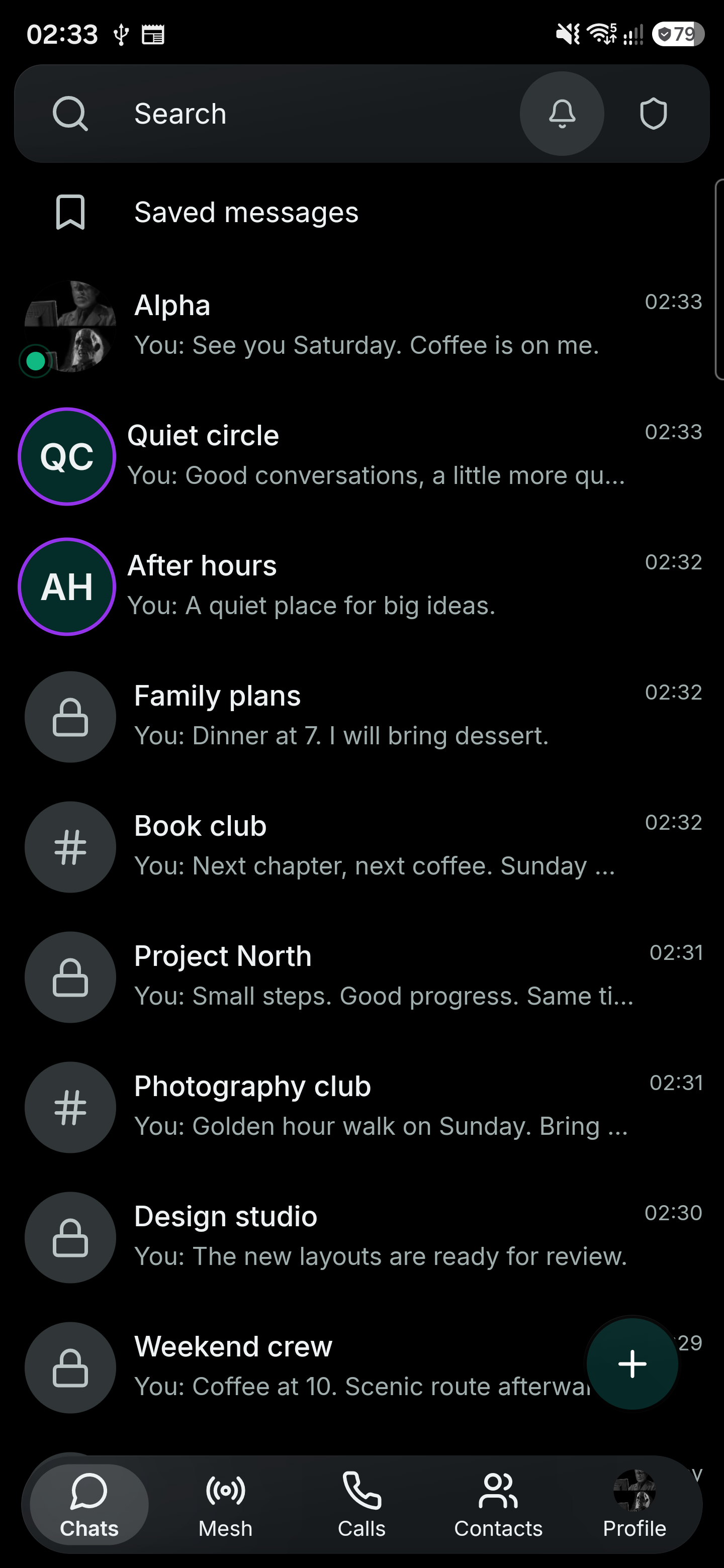
- Conversations privéesChiffrement de bout en bout avec libsignal
- Sans numéro de téléphoneÉchangez avec un nom d’utilisateur
- Shield + TorRoutage onion et boîtes anonymes en option
- Appels vocauxGardez le chat ouvert pendant l’appel
La présentation détaillée du projet est actuellement disponible en anglais.
From the current build
A closer look at Chatter
These captures come from my own Android phones. The conversations and channels are fictional demo content. Chatter is in closed alpha.
Your conversations, together
Direct chats, public channels, private spaces and anonymous groups in one home screen.
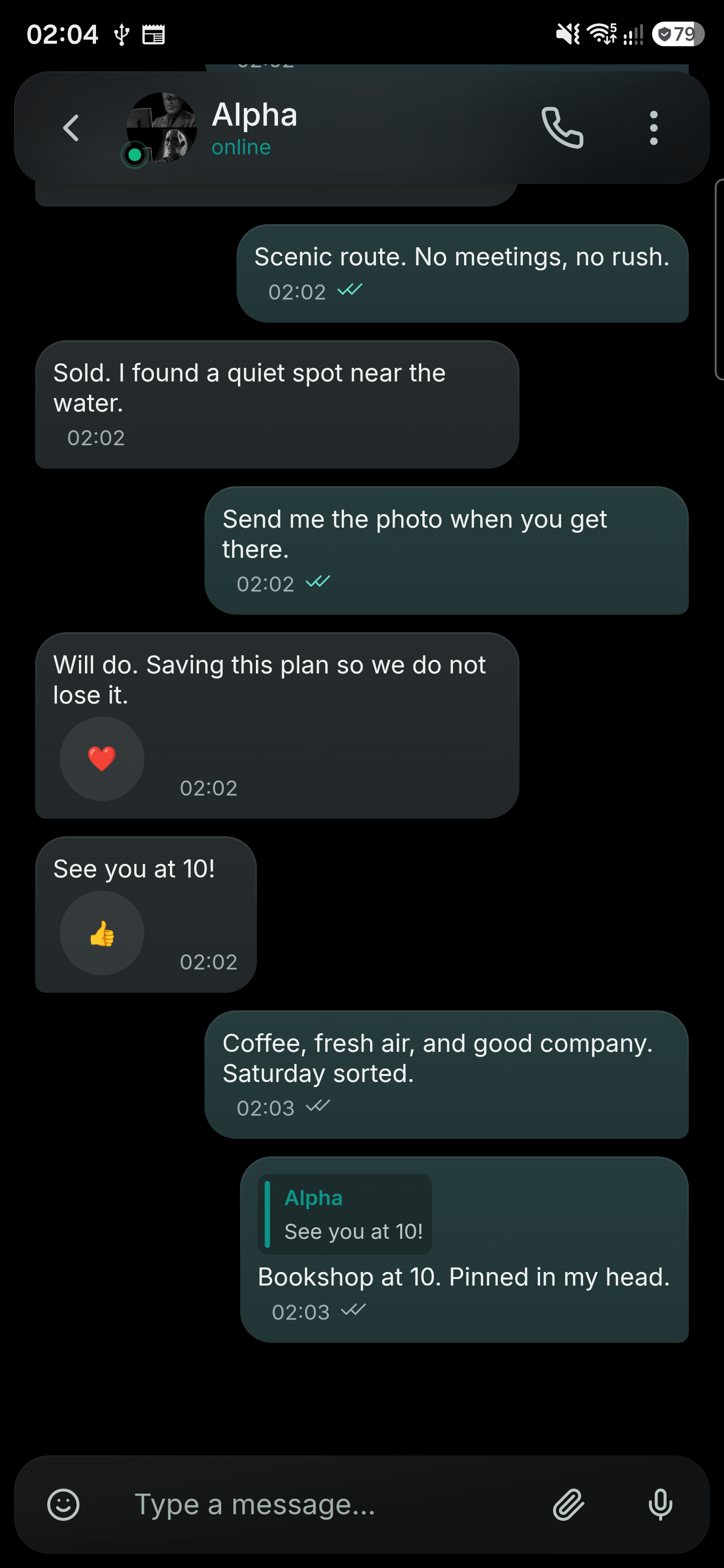
Replies that keep their context
Reactions, quoted replies, typing indicators and read receipts.
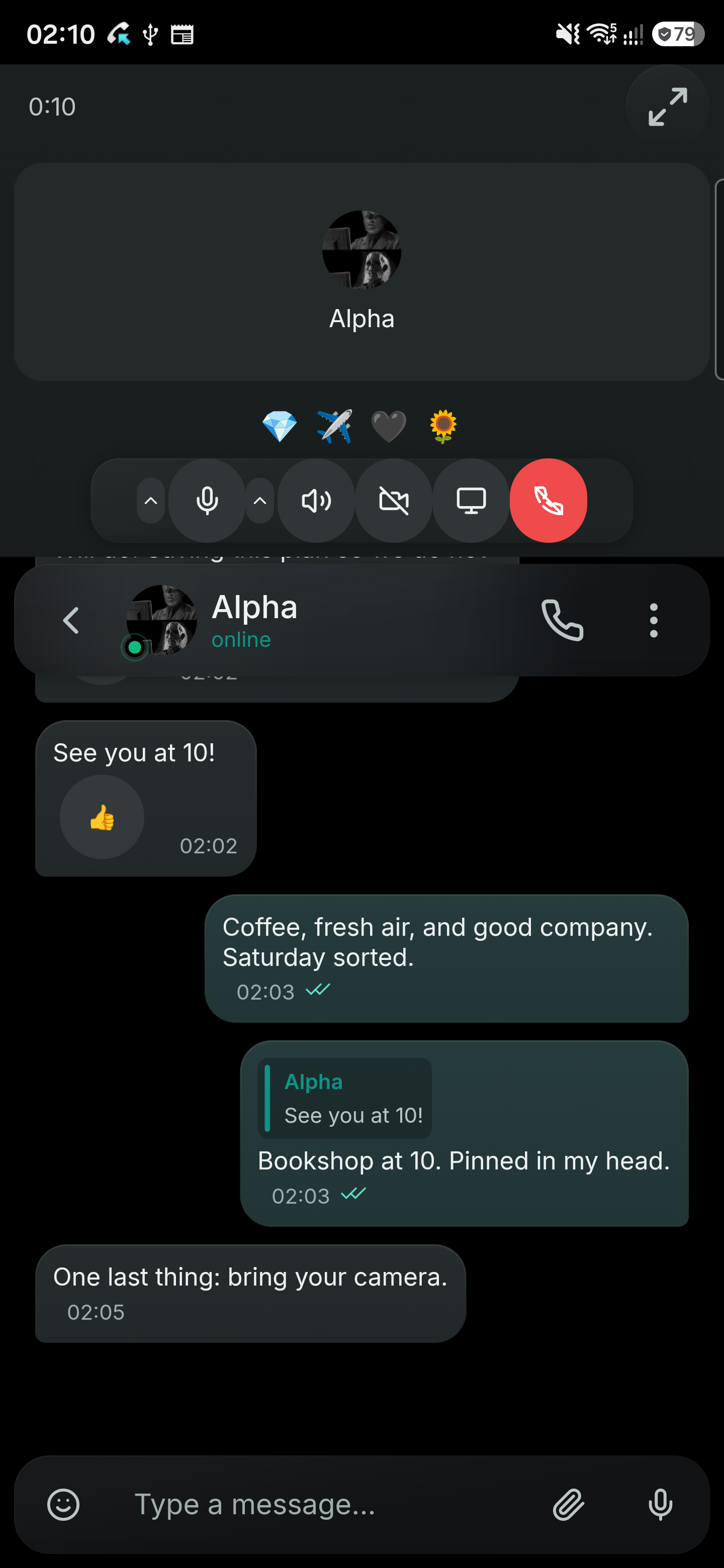
Stay in the conversation
A connected voice call can stay above the conversation or expand to fill the screen.
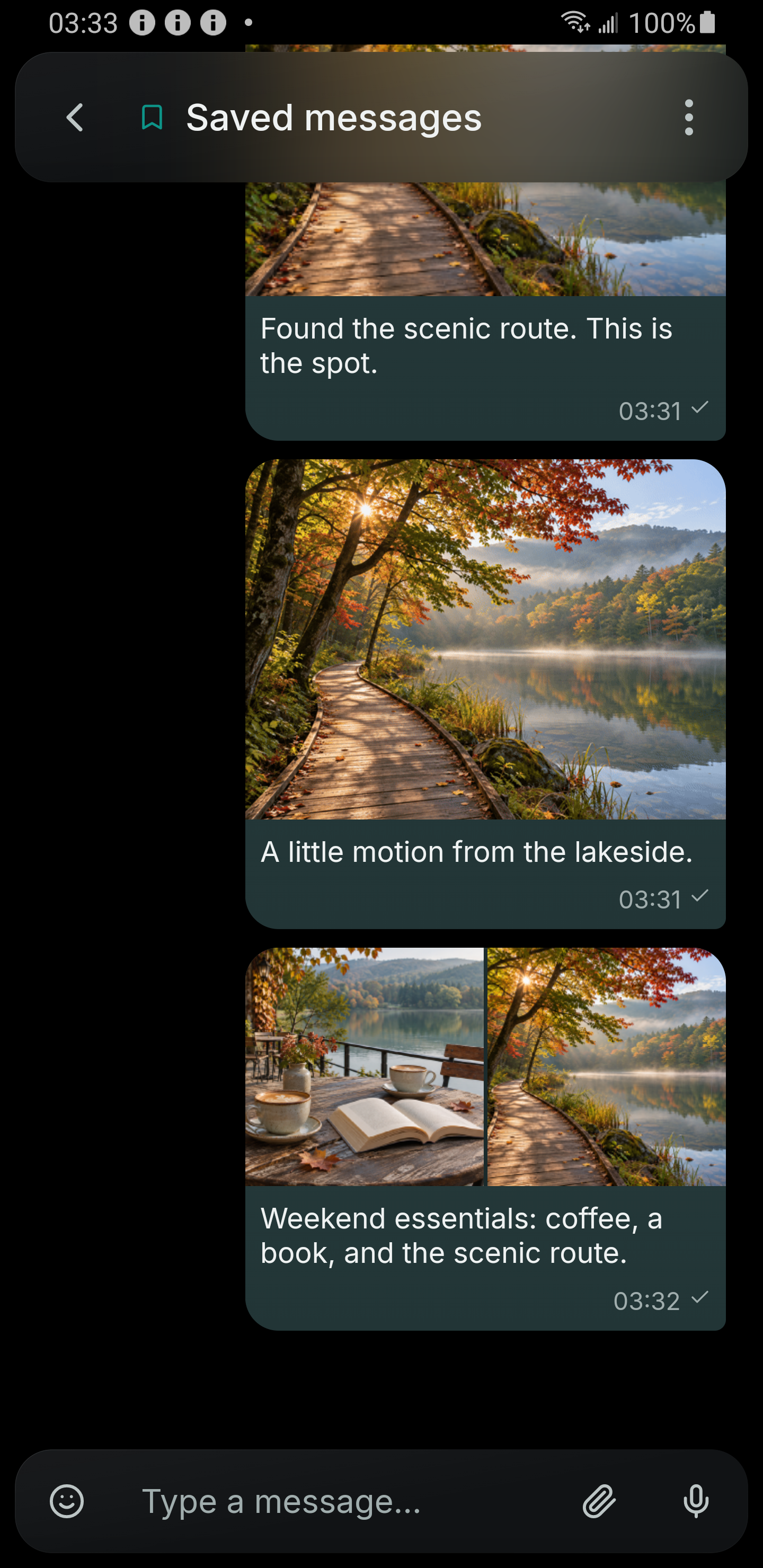
Photos, GIFs and albums
Text with media, animated attachments and multiple photos under one caption. AI-generated demo pictures inside the real app.
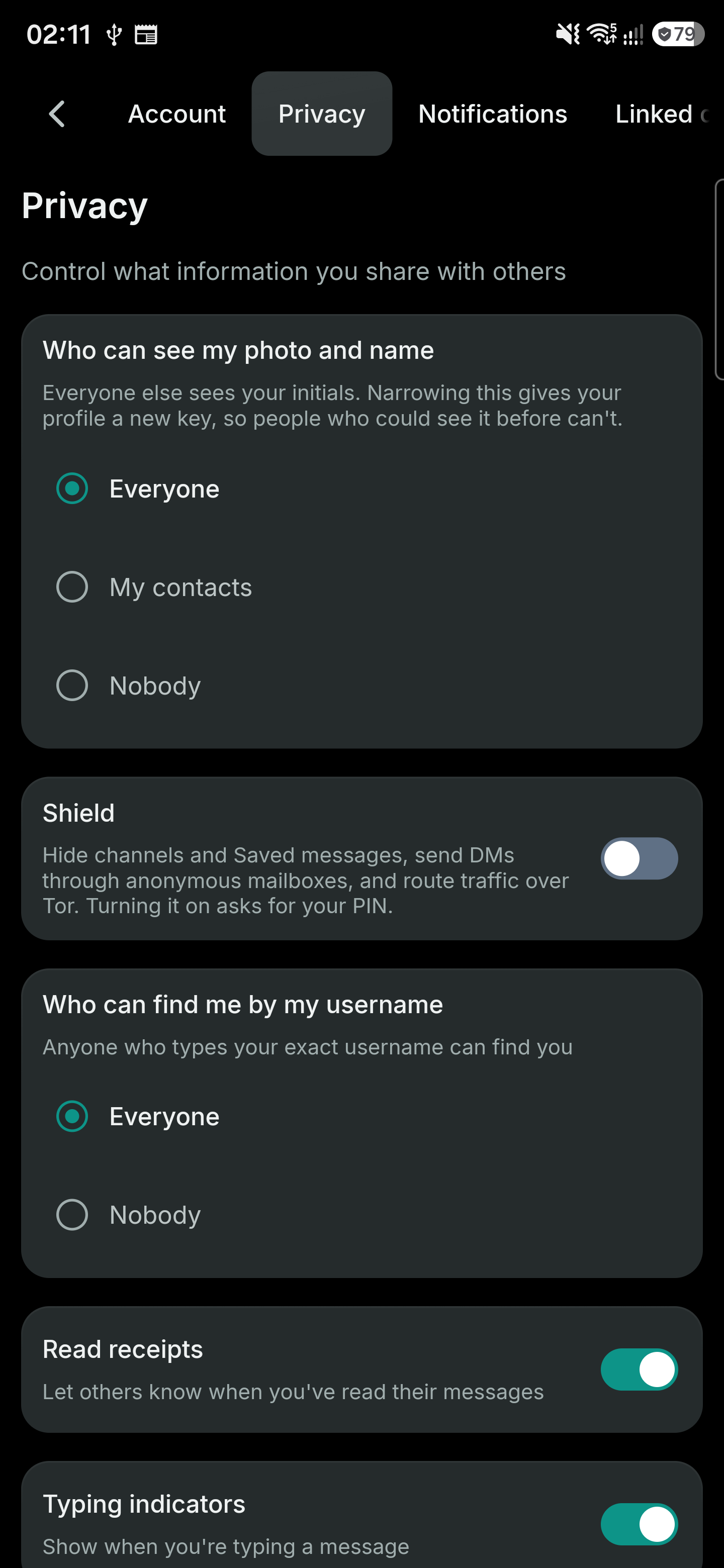
Choose what you share
Profile visibility, username discovery, read receipts, typing indicators and optional Shield mode.
More room on a tablet
The landscape layout keeps the conversation list beside your messages. Captured on a Samsung Tab S9 Ultra development build, with a fictional private mesh conversation.
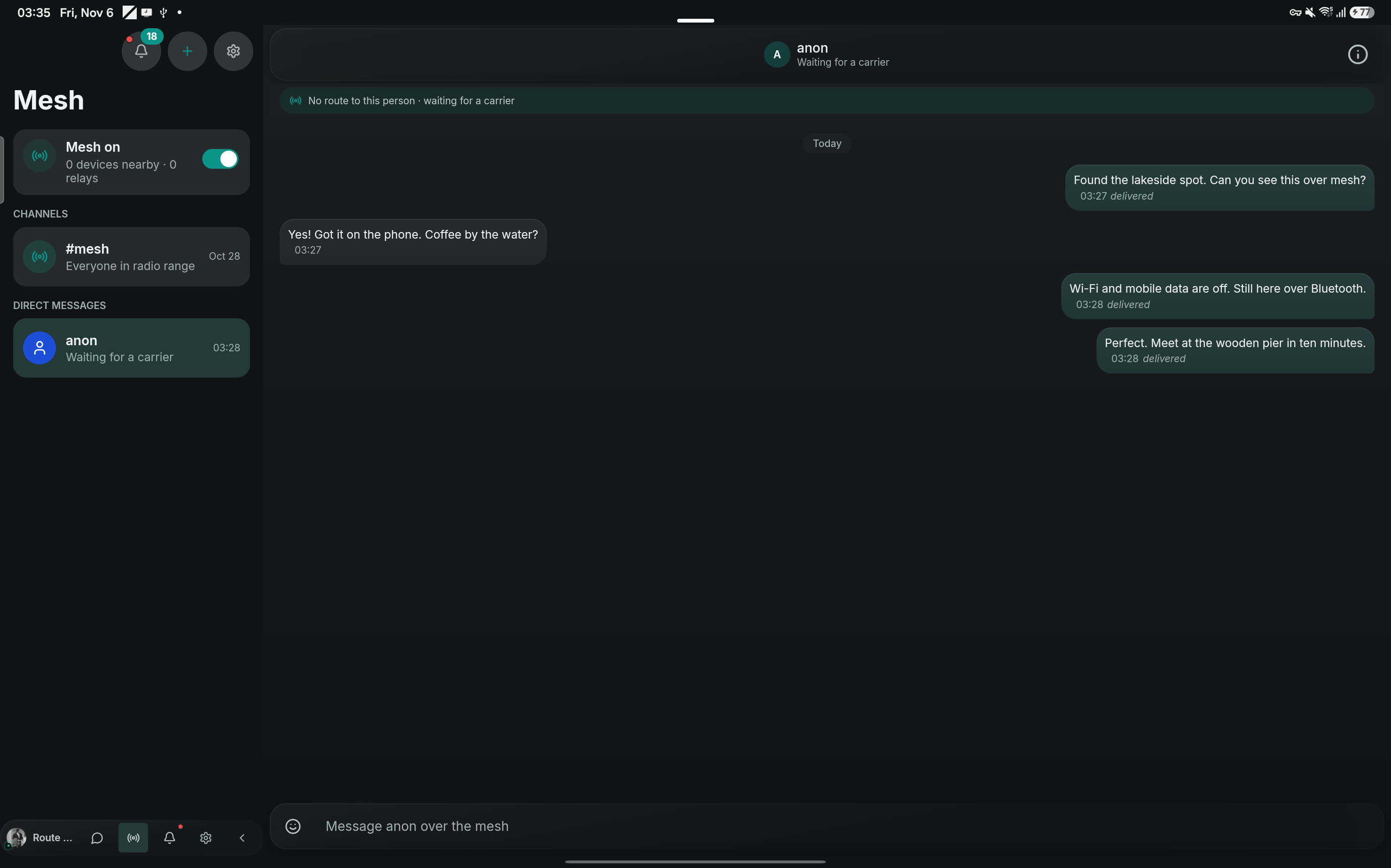
Mesh chat, without the Chatter server
Nearby devices can exchange messages over Bluetooth Low Energy. I disabled Wi-Fi and mobile data on my phone and tablet, then sent the message shown in this recording. This is a real nearby-device exchange, not a multi-hop range test.
Public #mesh channels are readable by nearby participants. Private mesh messages use Noise encryption; nicknames are self-asserted until you verify the peer. Optional Nostr relays require internet. Mesh and Tor-based Shield are separate features.
More than text
A captioned photo, GIF and two-photo album. Real app recording with AI-generated demo attachments.
A message arrives
Typing indicator, incoming message and conversation movement. Silent screen recording.
A call without losing your place
Switching between full-screen and compact views during a connected voice call. Silent screen recording.
One shared client, a build for each platform
Rust owns the messaging, encryption and local storage. Slint provides a shared interface that adapts to phone, tablet and desktop layouts. Platform adapters handle notifications, permissions, application lifecycle, cameras and audio.
This is a shared codebase compiled for each target, with native platform integration. It is not one executable that runs everywhere, and feature coverage varies by build.
- Client
- Rust + Slint: shared application logic and interface, with platform-specific adapters.
- Private messaging
- Signal Protocol through libsignal; SQLCipher for local message history.
- Transport
- HTTP/3 over QUIC for eligible direct connections, with HTTP/2 over TCP fallback. Shield uses Tor onion routing instead of direct QUIC.
- Mesh
- Nearby Bluetooth LE messaging; Noise-encrypted private mesh messages, public radio channels and optional Nostr relays.
- Calls
- LiveKit + WebRTC, with native audio and media integration.
- Backend
- Go + Protobuf/Connect RPC, PostgreSQL, Redis and Temporal.
- Metadata protection
- Optional Shield mode, Tor onion routing and blind-signed anonymous mailboxes.
- Deployment
- OVHcloud in France, containers, systemd and infrastructure as code.
| Platform | Current position |
|---|---|
| Android | Current closed-alpha device testing. The captures here are from real phones. |
| Linux | Active desktop development alongside Android. |
| Windows | Build support exists. Feature coverage varies; the cross-build configuration excludes LiveKit calls. |
| macOS | Desktop packaging exists; broader device validation is still needed. |
| iOS | App shell and Rust integration exist; the shared UI port is in progress. |
Encryption and metadata protection
Private conversations require end-to-end encryption: clients encrypt and decrypt the content, while the backend handles delivery. Public channels can send service-readable content; TLS still protects the network connection.
Shield adds metadata protection. When enabled and connected, it routes the client’s RPC traffic through Tor to the configured onion service and carries attachment transfers over Tor. Anonymous mailboxes use blind-signed tokens to reduce linkage between account authentication and mailbox activity.
Shield suspends direct account push and restricts third-party media fetches to avoid bypassing that routing. It is optional and resets on app restart. Authenticated operations can still identify an account, and traffic timing, volume and the size of the anonymity set remain relevant. This is metadata protection, not a claim of zero metadata or immunity to traffic analysis.
The app is still in closed alpha. An independent security audit is not being claimed.
Une protection au-delà du contenu
Shield protège les métadonnées grâce à Tor et aux boîtes anonymes avec signatures aveugles. Il réduit l’exposition de l’IP et le lien avec le compte, sans éliminer toute analyse du trafic.
Client Rust partagé. Backend Go.
Rust et Slint partagent le cœur et l’interface entre les builds. Go, Protobuf/Connect RPC, HTTP/3/QUIC, PostgreSQL, Redis et Temporal assurent le service. Android et Linux sont les priorités actuelles.